

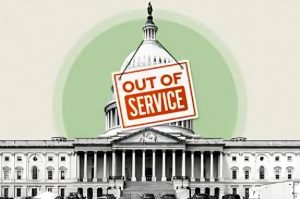
Washington: The US Government Shutdown 2025 officially began on October 1 after Congress failed to pass appropriations legislation, triggering major federal employee furloughs, service disruptions, and mounting economic consequences.
As Republican and Democratic deadlock deepens, especially over healthcare subsidies and budget allocations, the effects are rippling across agencies and states.
Why the Shutdown Happened: Policy Deadlock & Budget Impasse
At the heart of the shutdown lies a fierce legislative standoff.
Republicans attempted a clean continuing resolution, while Democrats insisted that any funding extension include restoration of health insurance subsidy protections under the Affordable Care Act.
Both proposals failed in the Senate, due to lack of bipartisan support. The Trump administration immediately froze $26 billion in funding to Democratic-leaning states, targeting transit and green energy projects, signaling political leverage in the shutdown.
Who’s Impacted: Furloughs, Agencies & Services
Roughly 750,000 federal employees have been furloughed, or must work without pay. Key agencies are hit hard:
- Health Agencies: HHS plans to furlough 41% of its staff; CDC to furlough 64%; NIH up to 75% will be cut back.
- FAA & Aviation: Over 11,000 FAA employees may be furloughed. Air traffic controllers and TSA continue, but travel delays may rise.
- Cybersecurity (CISA): Only ~35% of staff retained, exposing the U.S. to higher cyber risk.
- Credit Rating Risks: The credit rating agency Scope warns the shutdown intensifies U.S. downgrade risk.
Many discretionary services are suspended: national parks, visa processing, research funding, environmental programs, and more.
Essential services tied to national security, air traffic control, and courts continue in limited capacity. :contentReference[oaicite:7]{index=7}
US Government Shutdown 2025 : Economic Fallout & Weekly Loss Estimates
Analysts estimate the damage is steep. EY Parthenon calculates a weekly GDP hit of $7 billion, while a White House memo warns of up to $15 billion lost per week if shutdown endures.
Consumer spending could drop $30 billion in a month. Financial markets dipped as futures fell and the U.S. dollar traded defensively amid rising uncertainty.
Credit rating concerns and long-term risks loom.
What Continues & What Stops?
Continued: Mandatory programs like Social Security, Medicare, and Medicaid continue. The U.S. Postal Service, funded separately, also carries on.
Suspended or limited: Grant programs, research funding, discretionary programs, processing permits, new federal hiring, and many regulatory functions.
Short-Term vs Long-Term Outlook
Short-Term: The shutdown may last days to weeks as negotiations drag. Expect mounting pressure, possible extensions of programs piecemeal, and risk of permanent staff reductions if unresolved.
Long-Term: Recovery will be slow. Lost productivity is irretrievable.
Government departments may restructure, prioritize spending cuts, and overhaul subsidy and entitlement programs.
Credit and market confidence could be permanently shaken.
What Individuals & Local Areas Should Do
- Check for service disruptions in your city or state (e.g. parks, federal offices, grants).
- Those relying on federal employment or contracts should plan for delayed wages.
- Local governments in “Democratic-leaning states” may already feel funding cuts due to frozen programs.
- Stay updated via credible outlets and official agency notices.
The US Government Shutdown 2025 marks a significant crisis in American governance, one that affects federal workers, public services, and the national economy.
While some vital programs persist, widespread disruption is inevitable until Congress reaches a funding deal.
The longer it lasts, the deeper the damage. Stakeholders at all levels must brace for the consequences.