

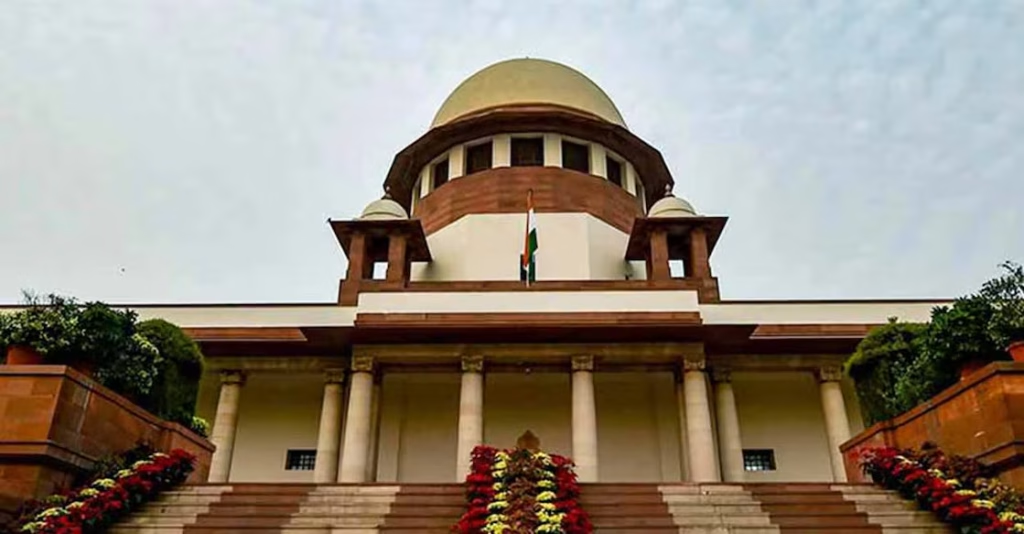
NATIONAL: Supreme Court Challenges Centre on Delayed State Bill Approvals
The Supreme Court’s Constitution Bench, presided over by Chief Justice B.R. Gavai, is rigorously examining the contentious issue of timelines for governors and the president in granting assent to bills passed by state legislatures.
The ongoing deliberations underscore a pivotal question: can judicial intervention address delays by constitutional functionaries?
Constitutional Duty vs. Judicial Oversight
During Thursday’s hearing, the bench, comprising Justices Suryakant, Vikram Nath, P.S. Narasimha, and A.S. Chandurkar, challenged Solicitor General Tushar Mehta, representing the Union, on the judiciary’s role when constitutional institutions falter.
The bench queried whether courts must remain passive when governors indefinitely delay assent, effectively stalling legislative processes.
The court emphasized that such delays undermine the democratic mandate of elected state legislatures. Chief Justice Gavai poignantly asked, “If governors suspend bills passed by people’s representatives, what is the meaning of democracy?”
Centre’s Stance on Political Resolutions
Mehta argued that the Constitution does not prescribe specific timelines for governors or the president to act on bills under Articles 200 and 201.
He advocated for political resolutions, urging chief ministers to engage directly with governors, the prime minister, or the president to resolve disputes rather than seeking judicial recourse.
He cautioned that judicially imposed timelines could encroach upon the constitutional prerogative of these offices. Mehta referenced the Tamil Nadu bill controversy, suggesting that any time limit should be legislated by Parliament, not mandated by the judiciary.
Judicial Intervention Justified?
Justice Suryakant countered, highlighting the varied approaches of governors across states, which often lead to prolonged delays.
He questioned whether the court should remain indifferent when states face governance disruptions due to such inaction, emphasizing the judiciary’s duty to uphold constitutional integrity.
The bench’s inquiry reflects a broader concern: can courts, under Article 142, prescribe timelines to ensure timely action without overstepping judicial boundaries? The hearing, poised to resume on August 26, 2025, continues to probe this delicate balance.
Implications for Federal Dynamics
The discourse underscores tensions in India’s federal structure, particularly when governors, often perceived as central appointees, delay state legislation. The court’s scrutiny could set a precedent for clarifying the scope of gubernatorial discretion and judicial oversight.
The outcome may redefine the interplay between constitutional authorities and judicial intervention, ensuring that legislative processes align with democratic principles without undue delays.