

International: Russia’s Bold Leap: 52 Satellites Soar
Historic Launch Achievement
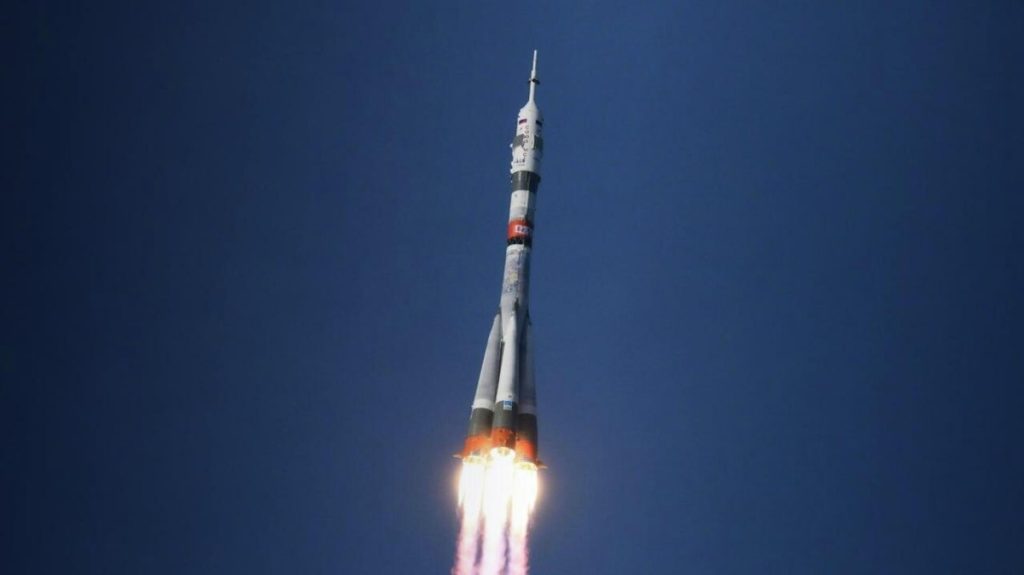
Russia‘s space agency, Roscosmos, marked a major milestone with the successful deployment of 52 satellites in a single mission. The Soyuz-2.1b rocket lifted off from the Vostochny Cosmodrome on December 28, 2025, carrying diverse payloads into a Sun-synchronous orbit around 550 kilometers high.
This event showcased Russia’s prowess in handling complex multi-satellite launches, using the Fregat upper stage to precisely place each one. It wrapped up the country’s orbital activities for the year on a high note.
Primary Earth Observation Satellites
The mission’s main focus was the Aist-2T pair, two 670-kilogram satellites built by RKTs Progress. These provide high-resolution stereo imaging of Earth’s surface, with panchromatic details down to 1.6 meters and multispectral at 4.8 meters.
Designed to last at least five years, they aid in creating digital terrain models and monitoring natural disasters like fires and floods. Their propulsion systems ensure stable operations for ongoing data collection.
Educational and Collaborative Efforts
A standout payload was the QMR-KWT-2, a 6U CubeSat developed by Sputnix for the UAE’s Mohammed Bin Rashid Space Centre and Kuwait’s College of Science and Technology. This educational tool promotes space interest in Arab nations through amateur radio broadcasts.
It fosters cooperation between Russia, UAE, and Kuwait, inspiring young minds in STEM fields. Such partnerships highlight growing international ties in space exploration.
Maritime Tracking Enhancements
Russia expanded its satellite-based Automatic Identification System with nine SITRO-AIS CubeSats, from 57 to 65. These 3U units track ship movements, especially along vital routes like the Northern Sea Route.
This upgrade improves maritime safety and navigation efficiency. The system helps monitor global shipping in real time, reducing risks in busy or remote waters.
IoT Technology Testing
Two SITRO-TD satellites, numbers 3 and 4, were included to test satellite-based Internet of Things capabilities. Built as 3U CubeSats, they explore connectivity for remote devices and data transfer.
Alongside the Marafon-IoT No.1 experimental satellite, these aim to advance IoT networks from space. A Marafon GVM mockup served as a mass simulator to validate designs.
Iranian Remote Sensing Contributions
Three Iranian satellites joined the mix: Kowsar-1.5, Paya (Tolou-3), and Zafar-2. These focus on Earth remote sensing, capturing images for environmental and resource management.
Weighing between 50 and 113 kilograms, they operate in low Earth orbit to gather valuable data. This collaboration strengthens Russia’s ties with Iran in space technology.
Diverse Secondary Payloads
The remaining satellites covered a wide range, including Belarus’s NASBSat-1 and 2 for unspecified research, and Qatar’s TriSat-3 picosat. Ecuador’s UTE-Galapagos and Montenegro’s Luca added to the international flavor.
Other notable ones like Zorky-2M series handle dual-use imaging, while university-built Ansat-1 and SCH-619 support optical and electromagnetic studies. This variety underscores the mission’s role in fostering global innovation.
- Aist-ST: Remote sensing experiments.
- Grifon series: Various research applications.
- Lobachevsky: Advanced imaging tasks.
- Mokha-1: Student-led project.
- MorSat-1: Part of UniverSat program.
- Mule-4T: Sub-satellite deployment carrier.
- Polytech Universe-6: Electromagnetic measurements.
- SakhaCube-Cholbon: Regional tech demo.
- Skorpion: Gamma ray detection.
- SM-3.1 and VM-3.1: Experimental platforms.
Broader Impacts on Space Sector
This launch not only boosts Russia’s satellite constellation but also enhances global monitoring tools. From disaster response to IoT connectivity, the payloads promise practical benefits for years ahead.
It reflects a trend toward cost-effective rideshare missions, making space accessible for smaller nations and organizations. Such efforts could spark more collaborative ventures in the future.