

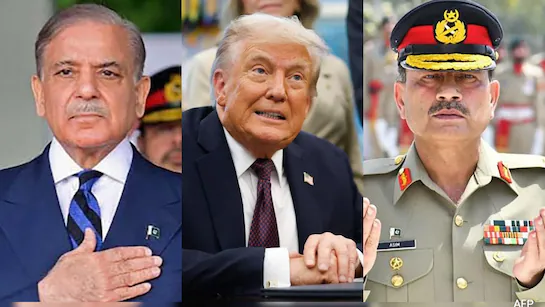
INTERNATIONAL: Trump Claims Pakistan Conducting Nuclear Tests
In a move that has sent ripples through global security circles, U.S. President Donald Trump announced the resumption of nuclear weapons testing after a 33-year pause.
This decision, revealed in a Truth Social post just before his summit with Chinese President Xi Jinping in Busan, South Korea, on October 30, 2025, underscores escalating tensions among major powers.
Trump framed it as a necessary response to perceived advances by rivals, signaling a potential shift in America’s post-Cold War restraint.
The announcement came aboard Marine One, en route to the high-stakes trade talks.
Trump wrote that he had instructed the Department of Defense to begin testing “on an equal basis” with other nations, citing Russia’s recent trials of nuclear-capable systems like a cruise missile and underwater drone.
He emphasized that the U.S. holds the world’s largest arsenal, capable of “destroying the planet 150 times over,” but refused to lag behind in verification efforts.
Spotlight on Rivals’ Activities
In a subsequent CBS News “60 Minutes” interview aired November 2, 2025, Trump defended the policy with pointed accusations.
He claimed nations such as Russia, China, North Korea, and Pakistan are actively conducting nuclear tests, often in secrecy underground where detection proves challenging.
“They don’t talk about it,” Trump said, contrasting this with America’s transparency as an open society.
Experts, however, urge caution on these assertions. While North Korea has openly detonated devices as recently as 2017, no verified explosive tests have occurred in Russia since 1990, China since 1996, or Pakistan since 1998, per monitoring by the Comprehensive Nuclear-Test-Ban Treaty Organization.
Recent Russian activities involved delivery systems, not warhead explosions, raising questions about whether Trump’s comments conflate missile trials with full detonations.
Arsenal Realities and Disarmament Hopes
Trump highlighted the U.S. edge in nuclear stockpiles, estimating over 5,000 warheads compared to Russia’s 5,459 and China’s growing 600.
He noted Beijing could close the gap within five years, prompting the need for reliable testing to maintain deterrence.
Yet, he expressed optimism for diplomacy, recalling discussions on arms reductions with Russian President Vladimir Putin and Xi.
The U.S. has relied on computer simulations and subcritical experiments at sites like Nevada’s National Test Site since 1992, avoiding full blasts to honor the voluntary moratorium.
Restarting could take 18 months to years for meaningful data, experts say, and might invite international backlash or fuel proliferation risks.
Global Echoes and Domestic Pushback
Russia’s Kremlin dismissed the move, clarifying their tests were non-explosive and hoping Trump was “properly informed.” China, through state media, called for restraint to avoid a “vicious cycle.”
Domestically, Democratic Senator Edward Markey introduced legislation to block funding, warning of a renewed arms race.
As preparations unfold without a set timeline or location, the world watches closely.
This pivot revives debates on balancing strength with stability, especially amid ongoing modernizations. Will it deter adversaries or deepen divides?