

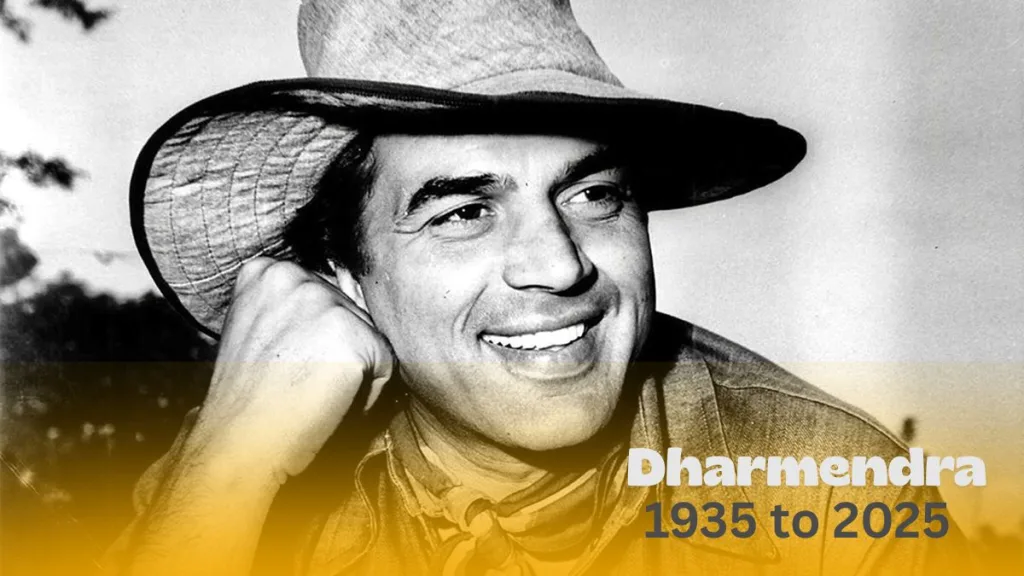
MOVIE DESK: Dharmendra’s Timeless Shine: From Village Soil to Stardom
The passing of Dharmendra on November 24, 2025, closes a vibrant chapter in Bollywood’s golden age.
At 89, the actor known for his magnetic screen presence leaves behind a legacy etched in over 300 films.
Fans and peers alike mourn a man whose journey from rural Punjab to stardom embodied the dreams of millions.
Humble Beginnings in Punjab
Born Dharmendra Kewal Krishan Deol on December 8, 1935, in the quiet village of Nasrali near Ludhiana, he grew up in a simple Punjabi Jat family.
His father worked as a headmaster, instilling values of hard work that shaped his resilient spirit.
By 1952, after completing school in Phagwara, young Dharmendra married Prakash Kaur, starting a family that would later include sons Sunny and Bobby Deol, and daughters Vijeeta and Ajeeta.
In 1980, he wed actress Hema Malini, welcoming daughters Esha and Ahana Deol into their blended household.
These personal milestones ran parallel to his rising career, grounding the action star in family ties amid the glamour.
Stepping into the Spotlight
Dharmendra’s Bollywood entry came humbly in 1960 with the modest Dil Bhi Tera Hum Bhi Tere, where he played a supporting role. Early breaks followed in films like Bandini (1963) and Ayee Milan Ki Bela (1964), showcasing his boyish charm and depth.
His first lead arrived in Haqeeqat (1964), a poignant war drama on the 1962 Sino-Indian conflict that earned critical acclaim and box-office success.
Romantic leads in Kaajal (1965) and the blockbuster Phool Aur Patthar (1966) solidified his appeal as a leading man.
These roles highlighted his versatility, blending tenderness with intensity, and set the stage for decades of stardom.
Rise as Action Hero and Romantic Lead
The 1970s marked Dharmendra’s peak, with action-packed hits like Mera Gaon Mera Desh (1971) cementing his “He-Man” image.
Romantic escapades such as Seeta Aur Geeta (1972) opposite Hema Malini sparked one of cinema’s iconic on-screen pairs, leading to over 20 joint ventures that captivated audiences.
1973 proved golden, with successive smashes Loafer, Jheel Ke Us Paar, and Yaadon Ki Baaraat.
The era-defining Sholay (1975), co-starring Amitabh Bachchan, became India’s biggest blockbuster, its dialogues still echoing in pop culture.
Key milestones in his filmography:
- Chupke Chupke (1975): Comic brilliance with Hema Malini
- Dharam Veer (1977): Fantasy adventure hit
- The Burning Train (1980): Multi-starrer thriller
- Ghayal (1990): As producer, a National Award winner
Beyond Acting: Production and Politics
Launching Vijayta Films in 1971, Dharmendra turned producer, kickstarting his sons’ careers.
Betaab (1983) launched Sunny Deol, becoming a massive earner, while Barsaat (1995) introduced Bobby Deol to cheering crowds.
Ghayal (1990) swept seven Filmfare Awards, underscoring his eye for talent.
Venturing into politics, he won the 2004 Lok Sabha seat from Bikaner on a BJP ticket, serving until 2009.
This phase reflected his grounded persona, bridging reel heroism with real-world service.
Accolades and Lasting Influence
Honored with the Filmfare Lifetime Achievement Award in 1999, Dharmendra grew teary-eyed on stage, reflecting on a career rich in hits yet light on individual trophies.
The Padma Bhushan in 2012 crowned his contributions, alongside FICCI’s “Living Legend” nod.
Even in later years, he shone in Rocky Aur Rani Kii Prem Kahani (2023), proving timeless charisma.
Dharmendra’s warmth off-screen inspired peers, his story a testament to perseverance from hamlet fields to global acclaim.