

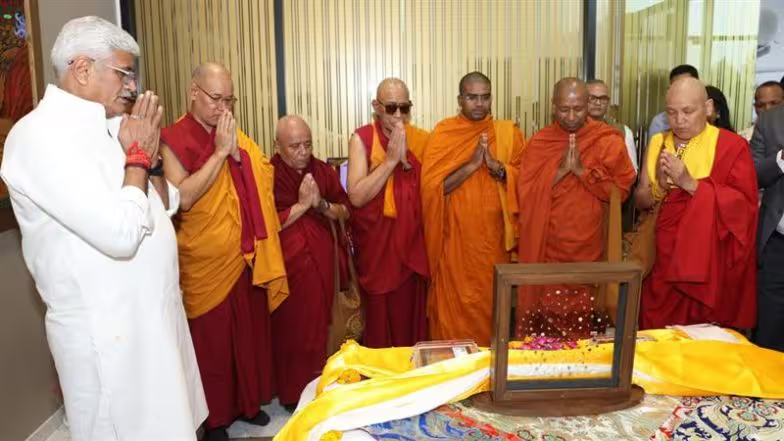
NATIONAL: Buddha’s Relics Return: India Reclaims Sacred Heritage
Historic Repatriation After 127 Years
Prime Minister Narendra Modi announced the return of the sacred Piprahwa relics of Lord Buddha to India, concluding a 127-year absence. Excavated in 1898 from a stupa in Piprahwa, Uttar Pradesh, these relics were removed during British colonial rule. Their repatriation marks a significant milestone in preserving India’s cultural and spiritual legacy.
Archaeological Significance of Piprahwa
The relics, discovered by British landowner William Claxton Peppé, include bone fragments, soapstone and crystal caskets, gold ornaments, and gemstones. Unearthed near the India-Nepal border, the site is believed to be part of ancient Kapilavastu, the Buddha’s childhood home. An inscription in Brahmi script confirms the relics’ association with Gautama Buddha, deposited by the Sakya clan.
Colonial Legacy and Global Dispersal
During British rule, most relics were sent to the Indian Museum in Kolkata, while some bone fragments were gifted to the King of Siam for distribution to Buddhist communities. A portion of the artifacts, retained by Peppé’s family, resurfaced in a 2025 Sotheby’s Hong Kong auction. The Indian government’s swift intervention halted the sale, facilitating their return.
Government’s Proactive Diplomacy
The Ministry of Culture, in coordination with the Ministry of External Affairs, issued legal notices to Sotheby’s and Peppé’s heirs, citing violations of Indian and international laws. This decisive action underscores India’s commitment to safeguarding its cultural heritage. Prime Minister Modi praised the collaborative efforts that ensured the relics’ homecoming.
Cultural and Spiritual Importance
The Piprahwa relics are revered as a direct link to the historical Buddha, holding profound significance for global Buddhist communities. Their return strengthens India’s cultural diplomacy, particularly with Buddhist-majority nations in South and Southeast Asia. The artifacts will likely be preserved for veneration and scholarly study.
Ethical Debate on Artifact Repatriation
The attempted auction sparked global criticism from Buddhist scholars and monastic leaders, who argued that sacred relics should not be commodified. The Indian government emphasized that these artifacts are inalienable heritage, protected under laws like the 1972 Antiquities and Art Treasures Act. This case highlights ongoing global discussions on repatriating colonial-era artifacts.
Future Preservation and Access
The relics, including a sandstone coffer currently housed at the Indian Museum in Kolkata, will be conserved for public and religious access. The government aims to balance veneration with scholarly research, ensuring the relics’ cultural and spiritual value is upheld. This repatriation sets a precedent for future recovery efforts.