

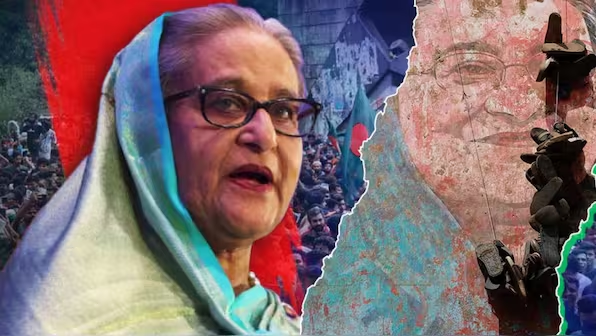
INTERNATIONAL: 2009 Bangladesh Rifles Mutiny: Former PM Hasina Linked to Shock Twist
A recent probe into Bangladesh’s 2009 border force revolt has leveled explosive claims against former Prime Minister Sheikh Hasina, painting a picture of calculated chaos.
Just weeks after her death sentence in a separate protest crackdown case, this report stirs fresh diplomatic ripples.
As Dhaka’s interim leaders push for accountability, the findings challenge long-held narratives and test ties with a key neighbor.
The 2009 Mutiny Revisited
The two-day uprising at the Bangladesh Rifles headquarters in Dhaka claimed 74 lives, mostly senior army officers, mere months after Hasina’s Awami League swept to power.
What began as a reported grievance over pay and conditions quickly escalated into one of the nation’s darkest episodes, with mutineers seizing arms and targeting commanders.
Earlier inquiries under Hasina’s watch pinned it on soldier frustrations, but critics whispered of deeper plots to curb military influence.
Now, 16 years on, a fresh commission offers a stark counterpoint, alleging orchestration from the top.
Allegations Against Hasina and Allies
The National Independent Investigation Commission, led by retired Major General A.L.M. Fazlur Rahman, submitted its report to Chief Adviser Muhammad Yunus on November 30, 2025.
It accuses Hasina of personally greenlighting the killings to safeguard her grip on power.
Key figures implicated include:
- Former MP Sheikh Fazle Noor Taposh, labeled the “principal coordinator” who relayed orders.
- Senior Awami League leaders like Sheikh Fazlul Karim Selim, Mirza Azam, Jahangir Kabir Nanak, and Sahara Khatun.
- Ex-military officials such as Tarique Ahmed Siddique, General Moeen U Ahmed, and Lt Gen Molla Fazle Akbar.
The panel describes a premeditated scheme, with planning stretching back to post-2008 election meetings in hidden spots.
Yunus hailed the disclosures as long-overdue clarity, vowing steps toward justice for victims’ families.
Claims of Indian Involvement
The report extends beyond borders, asserting “strong evidence” of external meddling aimed at destabilizing Bangladesh’s forces.
Commission members point to India as the main beneficiary, citing:
- Arrival of 921 Indian nationals in Dhaka around the mutiny, with 67 still untraced.
- Video footage of attackers using Hindi phrases during assaults.
- Intelligence linking the events to efforts to undermine the army, echoing 1971 war-era tensions.
Rahman urged Dhaka to demand explanations from New Delhi under bilateral pacts. No formal Indian rebuttal has surfaced, amid already tense relations soured by Hasina’s exile.
Hasina’s Exile and Extradition Pressures
Since fleeing to India on August 5, 2024, amid deadly student-led unrest, Hasina has resided in a secure Delhi spot.
The November 17, 2025, death penalty from Dhaka’s International Crimes Tribunal for protest-related atrocities has amplified calls for her return.
Bangladesh’s Foreign Ministry insists extradition is a treaty-bound duty, issuing fresh notes verbale.
India’s Ministry of External Affairs confirms review of the requests but holds off on decisions, stressing judicial processes.
As Dhaka mulls Interpol involvement, the standoff underscores fragile neighborhood dynamics.
Broader Implications for Justice and Stability
These revelations, blending old wounds with new verdicts, spotlight Bangladesh’s quest for reckoning under Yunus’s interim stewardship.
Families of the slain officers demand swift prosecutions, while the report’s foreign angle risks escalating cross-border frictions.
Yet amid the accusations, a quiet hope emerges: transparent probes could heal divides and fortify institutions.
In a region shadowed by history, will truth bridge the gaps, or widen them further?