

NATIONAL: Bloomberg Report Sparks Storm During Putin’s India Visit
A Bloomberg scoop on December 4, 2025, lit up headlines with claims of a fresh $2 billion nuclear submarine lease from Russia, timed neatly with President Vladimir Putin’s Delhi arrival.
Yet, hours later, India’s Press Information Bureau swung into action, labeling the narrative a distortion of facts.
This dust-up arrives as the leaders huddle for their 23rd annual summit, reminding us how fragile trust can be in the echo chamber of global news.
The Bloomberg Bombshell
Bloomberg’s piece, drawing from unnamed insiders, painted a picture of breakthrough diplomacy: India sealing a decade-long negotiation for an Akula-class attack submarine, complete with a 10-year lease for crew training.
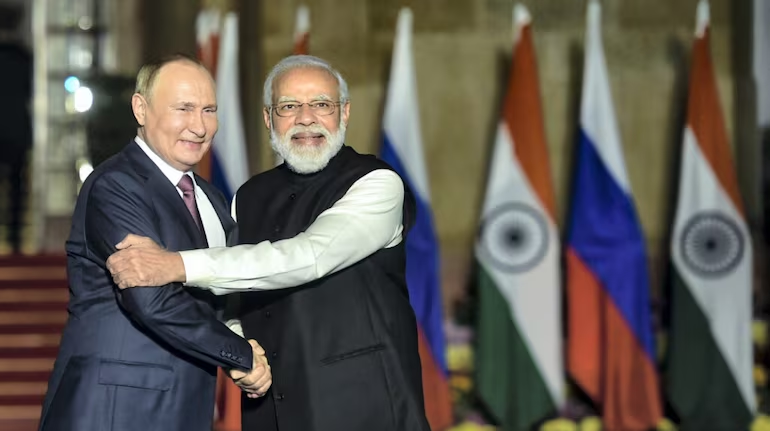
The report spotlighted November site visits to Russian yards and hinted at pricing hurdles finally cleared, all syncing with Putin’s tarmac embrace from Prime Minister Narendra Modi.
It struck a chord amid rising Indo-Pacific tensions, where nuclear subs symbolize quiet might.
For readers scanning feeds, it screamed “strategic win,” but the devil, as ever, hid in the timeline details that followed.
PIB’s Swift Fact-Check
Not missing a beat, PIB’s fact-check unit dropped a corrective on X, dissecting the headline as “misleading.” They zeroed in on the core: no ink has dried on a new pact. Instead, the buzz traces back to a March 2019 intergovernmental deal, delayed by production snags and now eyeing a 2028 handover.
This isn’t the first time media velocity outpaces precision. The post, racking up thousands of views, urged a closer read: the sub’s role stays training-focused, off-limits for frontline scraps, bolstering India’s homegrown nuclear fleet without fresh fiscal fireworks.
Roots of the 2019 Accord
Rewind to 2019, when India and Russia inked the lease amid a broader defense refresh. Priced around $3 billion originally, it echoed the Chakra III arrangement and returned in 2021 after a decade’s service.
This vessel, likely a Yasen-M variant, promises stealthier ops and longer dives, key for patrolling vast ocean flanks.
Delays? Blame yard overloads in Severodvinsk and tech tweaks for Indian specs.
Yet, it’s yielded gains: Indian crews logging sea hours, feeding know-how into Project 75I and SSBN programs.
No combat clause keeps it compliant with non-proliferation norms, a nod to wary Western eyes.
Enduring Threads in Indo-Russian Ties
Government insiders paint a canvas of 78 years’ worth of bedrock bonds, far beyond transactional trades.
Defense isn’t just procurement; it’s co-creation, with Russia as a steadfast partner in a multipolar maze.
From joint ventures to shared tech, it’s evolved into something resembling family, resilient against geopolitical gusts.
Picture this: T-90S tanks rumbling off Indian lines, Su-30MKI jets soaring from HAL hangars, and BrahMos missiles zipping from co-built silos.
These aren’t imports; they’re fused efforts, slashing costs and spiking self-reliance. Putin’s visit?
Expect chats on trade routes like INSTC, energy swaps, and maybe a wink at future subs, all underscoring a friendship that defies headlines.
What Lies Beneath the Buzz
This episode underscores a timeless truth in diplomacy: whispers can whip up waves, but facts anchor the ship.
As Putin and Modi toast over summit deals, the sub-story fades to a footnote, highlighting how old pacts quietly propel new horizons.
In a world quick to celebrate “clinches,” perhaps the real story is the steady hum of collaboration that needs no fanfare.