

NATIONAL: PM Ouster Bills Ignite Lok Sabha Fury
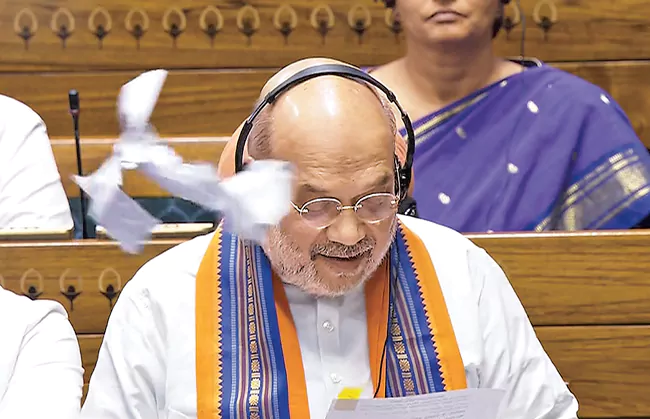
In a charged session of India’s lower house, Union Home Minister Amit Shah tabled legislation mandating the disqualification of elected officials, including the Prime Minister, 31 days post-arrest on grave offenses. The measures, embedded in three bills, elicited immediate backlash, underscoring fissures in parliamentary discourse.
Legislative Provisions Under Scrutiny
The proposed amendments target state chief ministers, central ministers, and the apex executive, enforcing automatic removal from office upon sustained detention for serious crimes. Proponents argue this upholds ethical governance, while detractors decry it as a tool for political vendettas.
These bills—the Union Territories (Amendment) Bill, the 130th Constitutional Amendment Bill, and the Jammu and Kashmir Reorganisation (Amendment) Bill—aim to fortify accountability mechanisms. Shah refuted claims of precipitous introduction, emphasizing moral imperatives for public representatives.
Opposition’s Constitutional Alarms
Parliamentary adversaries, including Asaduddin Owaisi of AIMIM and Congress figures like KC Venugopal and Manish Tewari, lambasted the initiatives as antithetical to federalism and judicial autonomy. They contended that such provisions could erode democratic safeguards, enabling arbitrary destabilization of regimes.
Concerns amplified over potential misuse, with opposition voices asserting that the laws jettison constitutional protections, fostering an environment ripe for partisan exploitation. Shah countered by highlighting his own past resignation on ethical grounds prior to legal acquittal.
Tumultuous Proceedings in the Chamber
Escalating dissent manifested in physical confrontations, as opposition members shredded bill copies, stormed the well, and chanted dissent. A Trinamool Congress parliamentarian attempted to seize Shah’s microphone, prompting deployment of marshals to shield the minister and the Speaker’s dais.
Union ministers and BJP allies formed a defensive perimeter around Shah, who temporarily relocated to a rear seat amid the melee. Security personnel from Parliamentary Services intervened, restoring order after multiple adjournments.
Prominent Critiques from Opposition Leaders
Priyanka Gandhi Vadra denounced the bills as draconian and anti-democratic, warning of unchecked executive overreach in ousting officials sans conviction. Rahul Gandhi likened the scenario to medieval autocracy, where arbitrary dismissals prevail.
Mallikarjun Kharge accused the administration of undermining parliamentary impartiality, while Mamata Banerjee of Trinamool Congress decried it as a systemic assault on pluralism, heralding a monolithic governance paradigm. Other factions echoed these sentiments across diverse fora.
Ministerial Rebuttals and Social Media Ripostes
Shah, via his X platform, juxtaposed the current regime’s self-subjection to legal scrutiny against historical precedents, critiquing opposition reluctance to relinquish power amid incarceration. Dharmendra Pradhan rebuked adversaries for ostensibly endorsing corruption.
The discourse highlighted ideological chasms, with the ruling coalition framing the bills as anti-corruption bulwarks against opposition portrayals of democratic erosion.
Referral to Joint Parliamentary Committee
Amid unrelenting protests, the Lok Sabha opted via voice vote to remit the bills to a 31-member Joint Parliamentary Committee for exhaustive review. Comprising 21 from the lower house and 10 from the upper, the panel must report by the winter session’s inaugural week’s close.
This deferral underscores procedural prudence, affording cross-party deliberation on the contentious reforms. The Rajya Sabha, concurrently, endorsed an unrelated measure establishing an Indian Institute of Management in Guwahati, prompting opposition walkouts.