

INTERNATIONAL: Bangladeshi PM Yunus Sparks Row with Distorted India Map
Ties between India and Bangladesh have felt the strain since Muhammad Yunus stepped in as interim chief adviser last year.
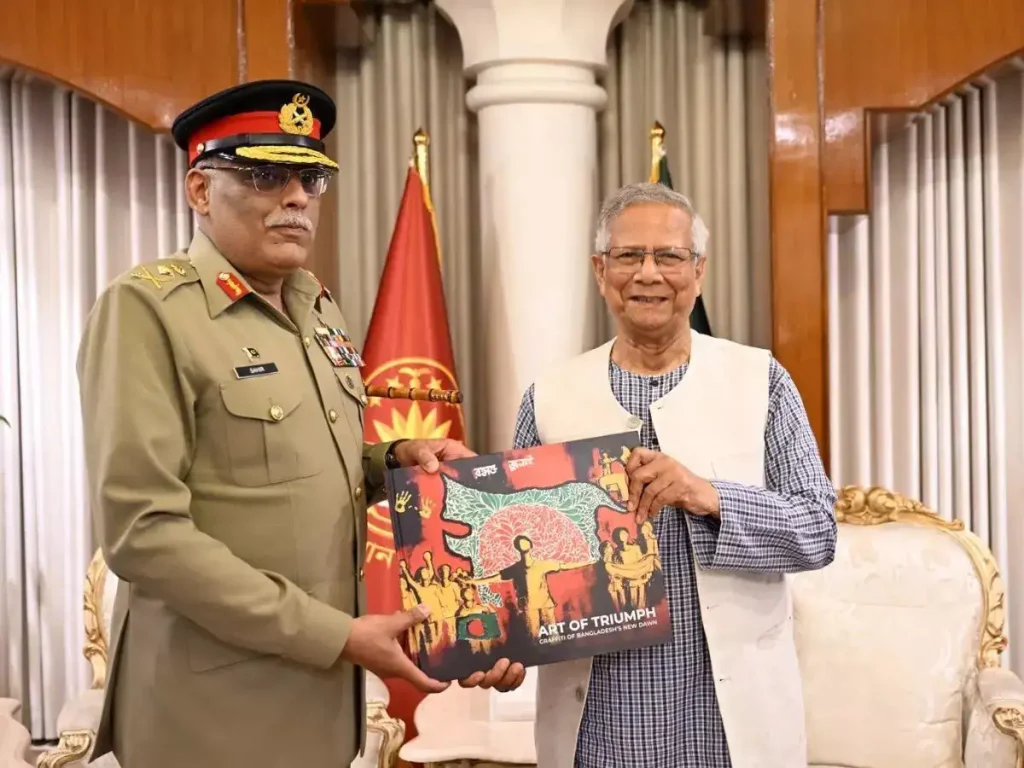
Fresh friction emerged this week when Yunus gifted a book to a top Pakistani military figure, its cover bearing a map that folds India’s northeastern states into Bangladesh’s borders.
The move, captured in photos from an official meeting, quickly fueled online outrage over territorial implications.
A Gift That Grates
During a visit to Dhaka, Pakistan’s Joint Chiefs of Staff Committee Chairman General Sahir Shamshad Mirza sat down with Yunus to discuss bilateral cooperation.
As a gesture, Yunus handed over “Art of Triumph,” a coffee table book celebrating Bangladesh’s spirit through graffiti art.
Yet the artwork on its front, a stylized outline in national colors, stretches beyond recognized lines, encompassing Assam and six other northeastern Indian states.
This isn’t mere oversight; the same design sparked debate earlier this year at a Dhaka University exhibit.
Social media erupted with sharp rebukes, users decrying it as a blatant slight to India’s sovereignty.
Hashtags trended across platforms, blending calls for diplomatic pushback with memes mocking the “expanded” borders.
For many in the Northeast, the imagery hit close to home, reviving old sensitivities about regional identity.
Patterns in the Past
Yunus’s latest act echoes earlier statements that irked New Delhi. Back in March, during a Beijing trip, he highlighted India’s “Seven Sisters,” the northeastern states, as landlocked, positioning Bangladesh as their vital sea corridor and a launchpad for Chinese ventures.
He framed it as a win-win for economic ties, but Indian observers saw it as an overture to external powers.
By May, Yunus pivoted to pitch a sweeping economic blueprint linking Bangladesh with Nepal, Bhutan, and those same Indian states.
Proponents viewed it as pragmatic regionalism; critics, however, flagged it as blurring sovereign lines without mutual consent.
New Delhi’s Measured Pushback
India wasted no time in April when Yunus’s China remarks surfaced. External Affairs Minister S. Jaishankar, speaking at a BIMSTEC forum, underscored India’s 6,500-kilometer Bay of Bengal shoreline and its role linking five member nations.
“Our Northeast is fast becoming a connectivity powerhouse, tied to the Pacific via roads, rails, and more,” he noted, adding that true partnership defies “cherry-picking” agendas.
This response wasn’t just rhetoric. It spotlighted ongoing projects like the India-Myanmar-Thailand Trilateral Highway, reinforcing the region’s integration on India’s terms.
Ties Tightening Across Borders
The Yunus-Mirza encounter fits a broader thaw between Dhaka and Islamabad, dormant since 1971.
Trade talks and military exchanges have picked up pace under Yunus’s watch, signaling a recalibration in South Asian dynamics.
For India, watching from the sidelines, it raises questions about balancing old alliances with emerging realities.
As envoys huddle behind closed doors, the episode underscores how symbols can snag even the steadiest diplomatic threads.